

Chances are, Your Teen has NOT Sexted
Despite a recent headline announcing the opposite, most teens do not sext. Kelly Wallace wrote an article for CNN back in November which was updated and reposted last week. Most of the content of the article is accurate, and I certainly appreciate that she referred to published research and interviewed people who know what they […]
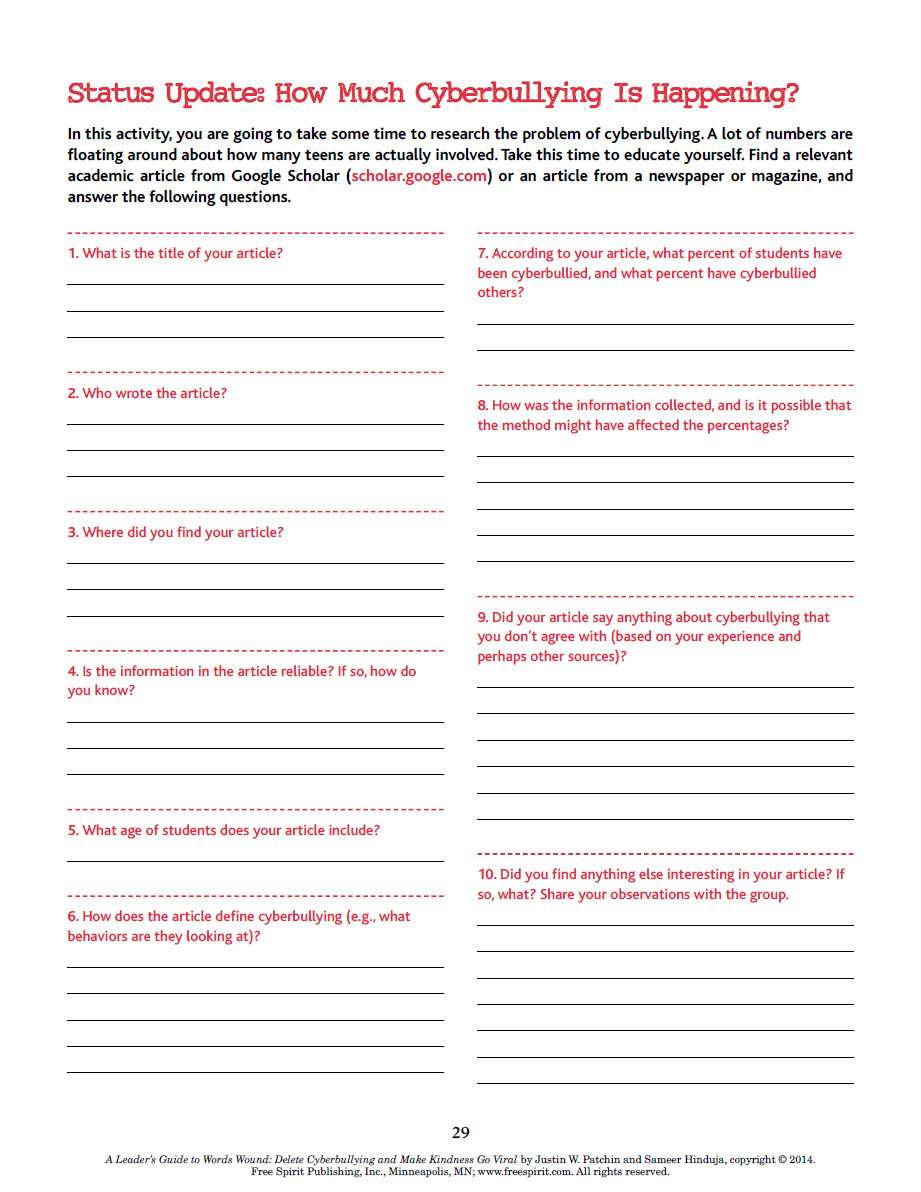
Cyberbullying Activity: Research
Use this Cyberbullying Research activity to help your students better understand the nature and extent of cyberbullying behaviors. Patchin, J. W. & Hinduja, S. (2014). A Leader’s Guide to Words Wound. Minneapolis, MN: Free Spirit Publishing. Download PDF You can also download the complete (and free!) Leader’s Guide to Words Wound by clicking here.

The Case for Including Intent in a Definition of Bullying
Last week I presented at the International Bullying Prevention Association’s annual conference in San Diego, CA. This was the second time that I have participated in this event, and both experiences were enjoyable and educational. The attendees (over 700 strong this year) are generally very interested in the work that we are doing at the […]

Distinguishing Bullying from Other Hurtful Behaviors
In my last post on this blog I wrote about the difficulty in determining when mean behavior crosses the line and becomes bullying behavior. I also discussed the challenge for researchers in trying to quantify the difference. In this post, I’d like to talk about why it is important to establish such a line. As […]
Cars Kill More Teens than Computers and Cell Phones Combined
University of New Hampshire sociology professor David Finkelhor recently wrote a short, but thought-provoking, commentary that questions the motives of journalists and scholars in their efforts to explain the nature and extent of risks associated with teen technology use. The impetus for this invited-editorial was an article written by Sonia Livingstone and Peter Smith published […]

Cyberbullying Research: 2013 Update
It’s been nearly three years since I posted a summary of the current state of cyberbullying research on this blog. That post was inspired by my concern that no researchers were included on a panel that testified to the Committee on Education and Labor’s Subcommittee on Healthy Families and Communities on the topic of how […]
Cyberbullying Myths and Realities
Bullying has long been a concern of youth advocates (e.g., educators, counselors, researchers, policy makers). Recently, cyberbullying (bullying perpetrated through online technology) has dominated the headlines as a major current-day adolescent challenge. This article reviews available empirical research to examine the accuracy of commonly-perpetuated claims about cyberbullying. The analysis revealed several myths about the nature […]
Cyberbullying Among Adolescents: Implications for Empirical Research
Research into the causes and consequences of cyberbullying among adolescents has exploded in the past 5 years [1]. However, much of the literature is largely descriptive in nature and/or suffers from methodological limitations associated with accessing and studying young people who are engaged in constantly changing high-tech behaviors. These challenges notwithstanding, a clearer picture is […]

Does Bullying “Cause” Suicide?
The title of Deborah Temkin’s recent Huffington Post article is a simple request: “Stop saying bullying causes suicide.” Her plea is understandable and justified. Sameer and I also cringe when we read the ubiquitous headlines espousing the conventional wisdom proclaiming that “bullying causes suicide.” But what does the research actually say about the nature of this […]

School Climate 2.0: Reviews and Response
Since our book School Climate 2.0: Preventing Cyberbullying and Sexting One Classroom at a Time was published last year, the response has been amazing. Many educators have come up to us at events around the country to tell us how much they really appreciate the research-based information and strategies that they can put to use […]