
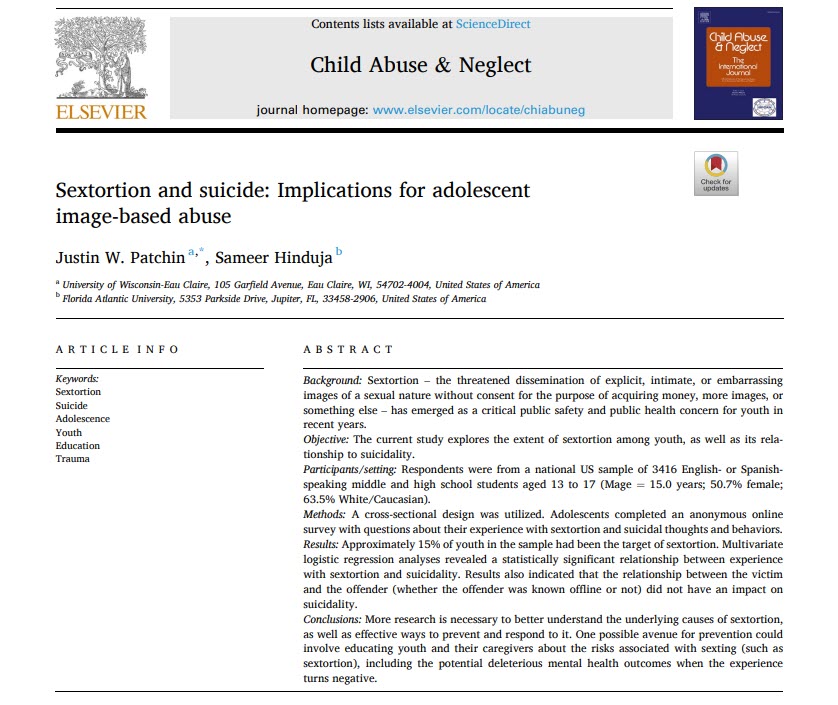
Sextortion and Teen Suicide
Seventeen-year-old Jordan DeMay met a pretty girl on Instagram who convinced him to share an explicit photo. After he did, “she” demanded $1,000. Fifteen-year-old Bradyn Bohn connected with someone on Facebook who made him laugh. He too was persuaded to share a private image. The new friend demanded money, or the images would be shared […]

Sextortion and Suicide: Implications for Adolescent Image-Based Abuse
Background: Sextortion – the threatened dissemination of explicit, intimate, or embarrassingimages of a sexual nature without consent for the purpose of acquiring money, more images, orsomething else – has emerged as a critical public safety and public health concern for youth inrecent years.Objective: The current study explores the extent of sextortion among youth, as well […]
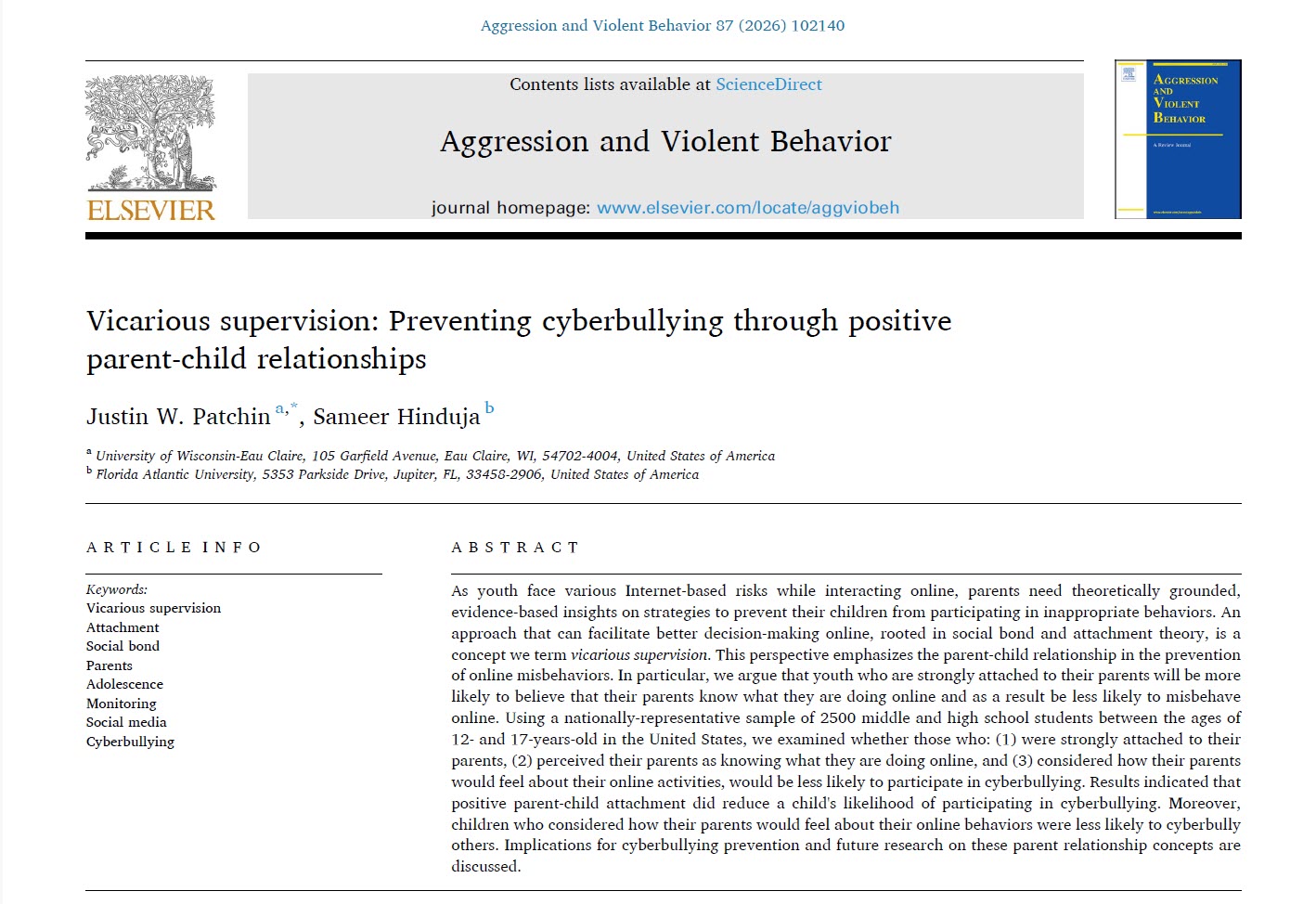
Preventing Cyberbullying Through Vicarious Supervision: Results from New Research
I’ve long been interested in the role of parents in preventing children from participating in problematic behaviors online. Parents should talk with their children about the responsible use of technology and allow access to apps and games at developmentally appropriate ages and in proper amounts. They should also utilize appropriate tools to restrict incidental access […]

Vicarious Supervision: Preventing Cyberbullying Through Positive Parent-Child Relationships
As youth face various Internet-based risks while interacting online, parents need theoretically grounded, evidence-based insights on strategies to prevent their child(ren) from participating in inappropriate behaviors. An approach that can facilitate better decision-making online, rooted in social bond and attachment theory, is a concept we term vicarious supervision. This perspective emphasizes the parent-child relationships in […]

Can a School Suspend a Student for Writing an Email that was Never Sent?
On the morning of October 9, 2024, “N.M.,” a sophomore at Marana High School in Marana, Arizona, was sitting next to his mother, Karalee Merrill, complaining about a poor grade he had received on an English assignment. His mom suggested he email the teacher to inquire about how to improve his grade. N.M. opened his […]
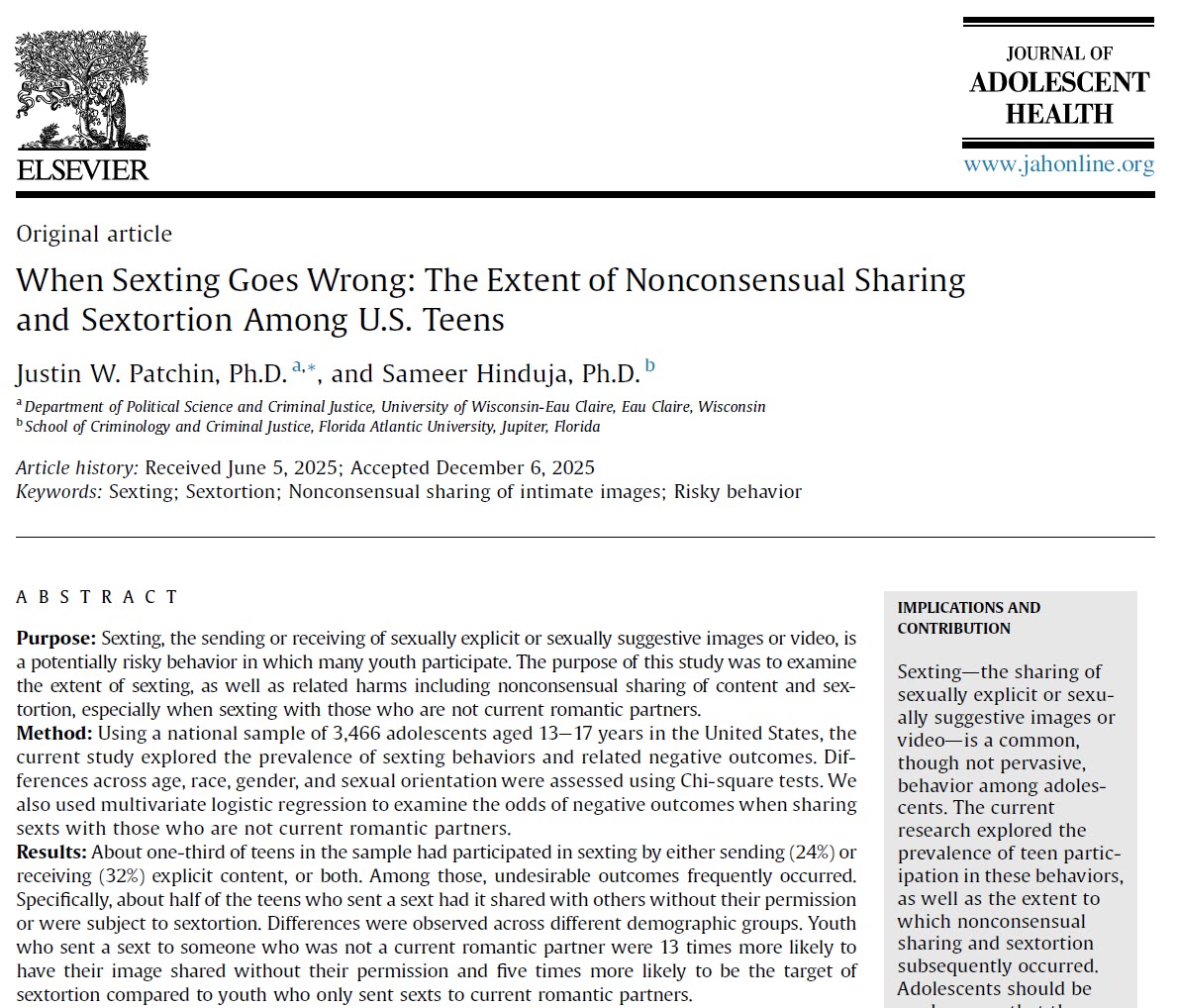
New Research Shows Teen Sexting and Risk of Sextortion is Increasing
Sameer and I first collected data on teen sexting nearly a decade ago and found that 7-11% of 12-17-year-olds in the US had sent a sexually explicit image of themselves to someone else. About 15% had received such an image from someone else. Last year, we replicated this research and found that 24% of 13-17-year-olds […]

Bradyn’s Law: Wisconsin’s Effort to Combat a Rise in Youth Sextortion
Bradyn Bohn was a 15-year-old freshman in the DC Everest School District in central Wisconsin. He loved sports, music, and making people laugh. Like most teens, he spent a lot of time online. One night in early March of this year, he met someone on Facebook who was fun and cute. While the details are […]

Cyberbullying Rates Continue to Climb – Especially Among Boys
We recently collected another round of data from middle and high school students in across the United States. This sample includes about 3,500 English or Spanish speaking 13- to 17-year-olds. We used age, race, gender, and region quotas to match U.S. Census demographics as closely as possible. This is the fifth national survey we’ve conducted […]
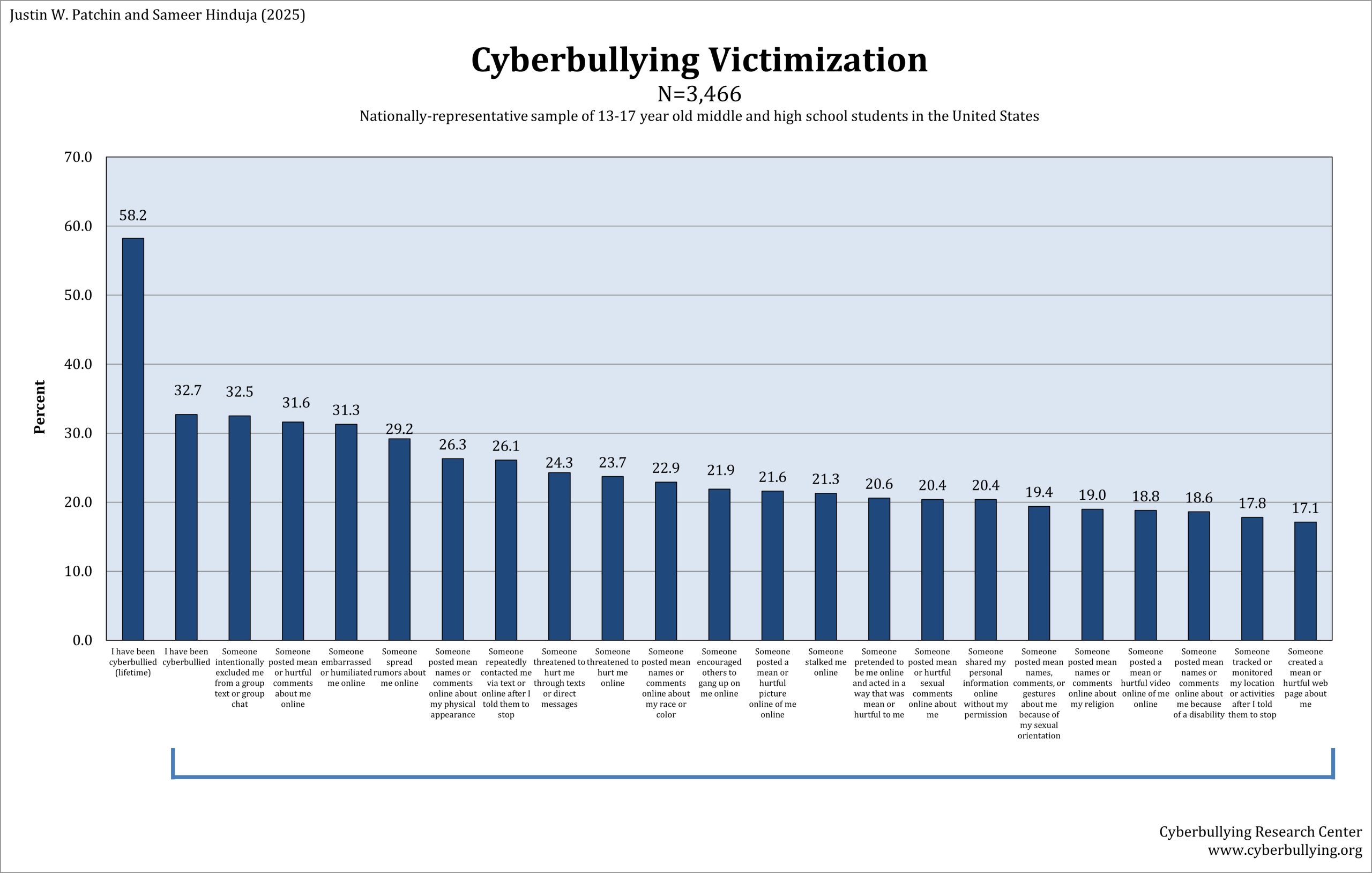
2025 Cyberbullying Data
This study surveyed a nationally-representative sample of 3,466 English or Spanish-speaking middle and high school students between the ages of 13 and 17 in the United States. Data were collected in May of 2025. Click on the thumbnail images to enlarge. Cyberbullying Victimization. We define cyberbullying as: “Cyberbullying is when someone repeatedly and intentionally harasses, […]

Our Cyberbullying Scale: Two Decades of Measuring Online Aggression
When Sameer and I first became interested in studying cyberbullying back in 2001, we began our inquiry by simply speaking with folks. We talked with parents and teens, but also with teachers and other school staff, as well as law enforcement officers and anyone else who worked with young people. We wanted to know more […]